Dada Room
Scalable Marketplace Capabilities (Discovery · Contact · Trust)
Outcome
Built a role-aware marketplace foundation—unified discovery across inventories, quality-gated contact mechanics, and systemized patterns—so users could progress from exploration to qualified contact with confidence.
Role
Co-founder & Head of Product & Design (platform strategy, UX systems, growth experimentation, monetization surfaces)
Año
2012–2018 (time-series results shown 2015–2018; product KPIs highlighted 2018)
Industria
Marketplace · Housing / Rentals
Team / Stakeholders
Startup team (product/design + engineering), plus cross-functional partners across operations, marketing, and customer support.
TL;DR
Problem
As Dada Room grew, the marketplace evolved from a simple two-sided model into multiple sub-markets with users switching roles over time. That complexity increased decision friction, lowered trust, and made “contact” noisy—putting marketplace health at risk.
Strategy
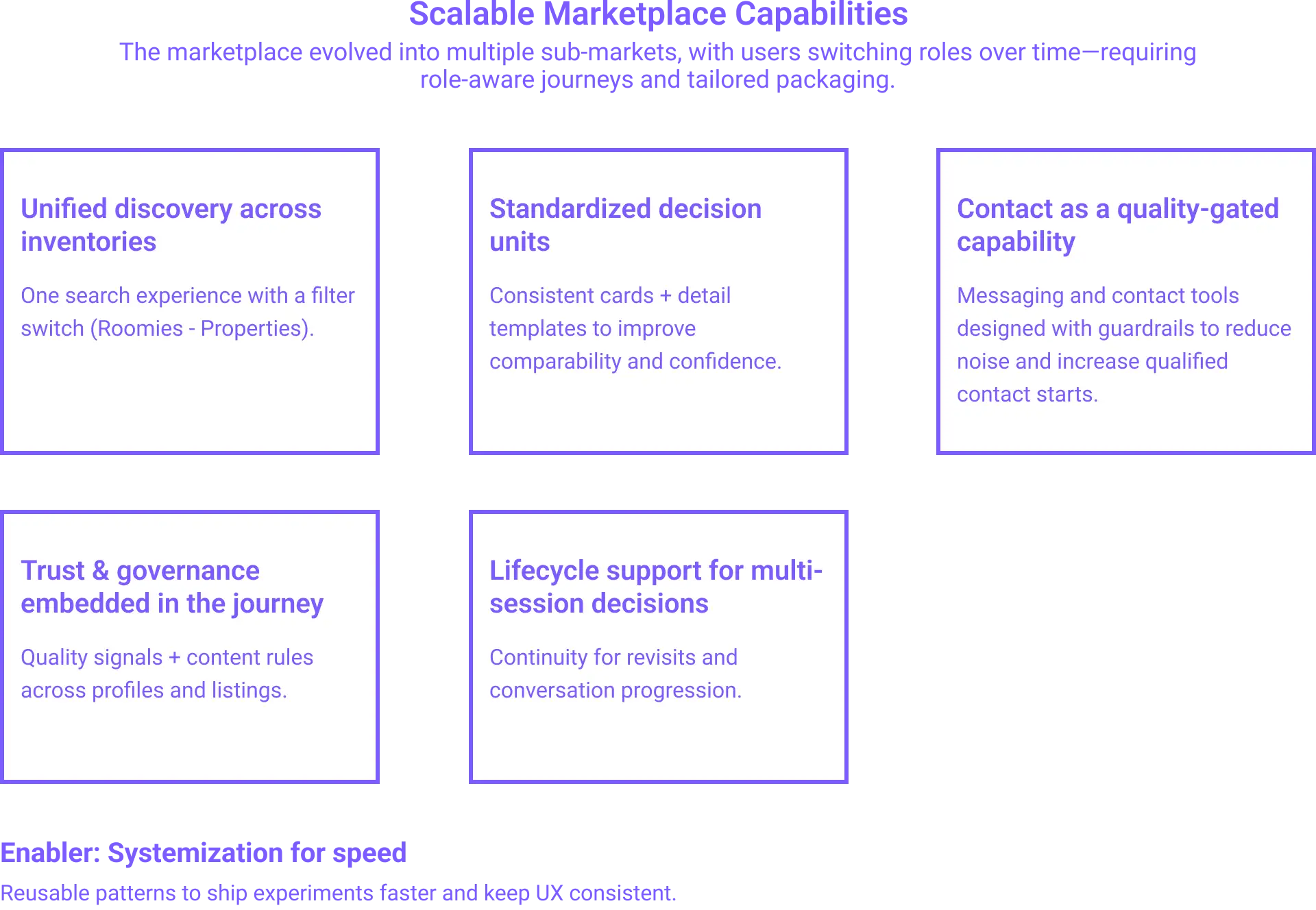
Build scalable platform capabilities—<b>unified discovery across two inventories</b> (people and places), standardized decision units (cards + detail templates), and quality-gated contact mechanics that protect trust while enabling monetization. Systemize patterns to increase iteration speed as segments and journeys multiplied.
Impact
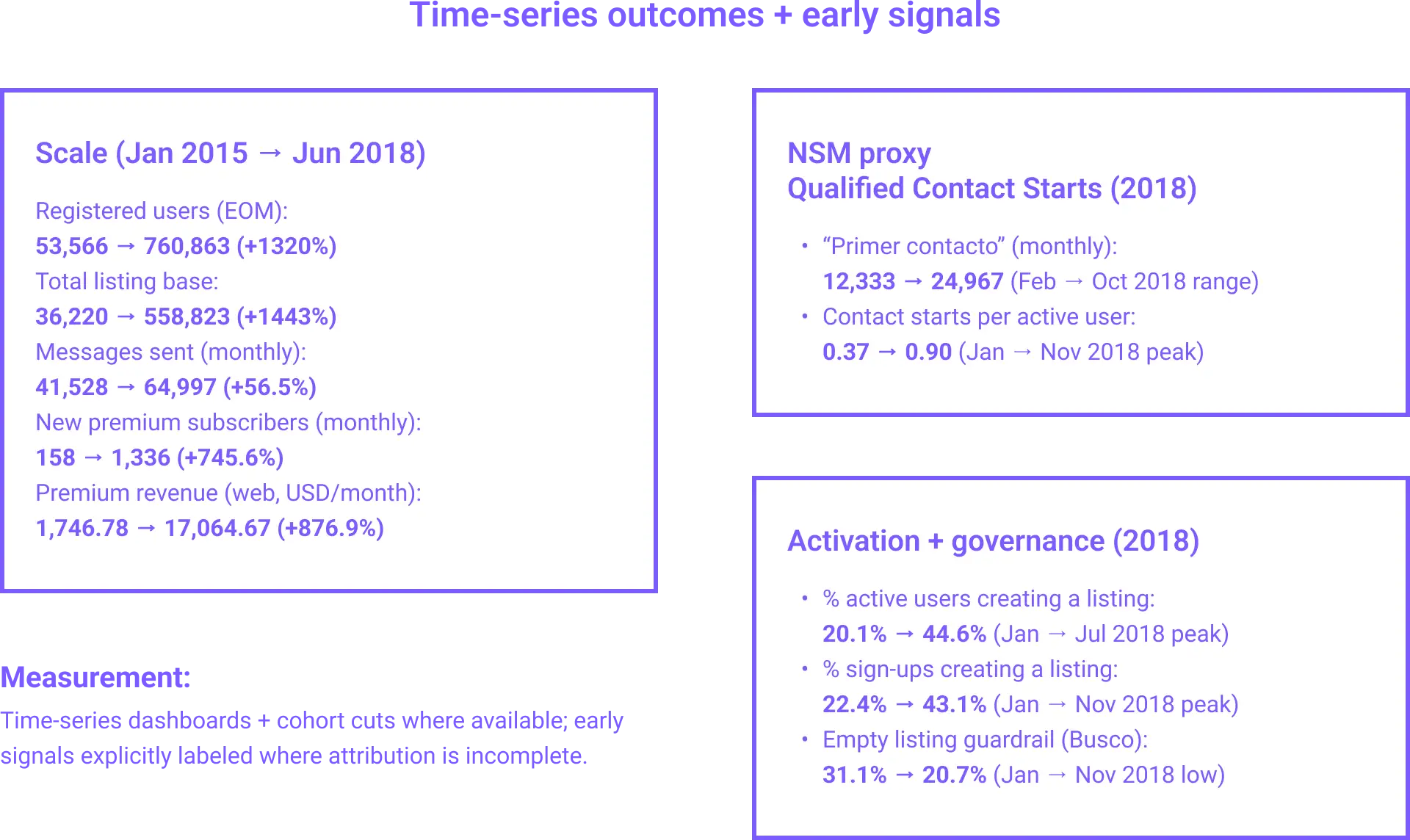
Platform scale and monetization grew over multi-year periods (users/listings, premium subs, premium revenue). In 2018, “qualified contact” proxies improved materially (first-contact message volume and contact starts per active user), alongside higher listing creation conversion (supply activation). Measurement method: time-series dashboards and cohort cuts where available; early signals explicitly labeled when attribution is incomplete.
Metric Tree & Success Criteria
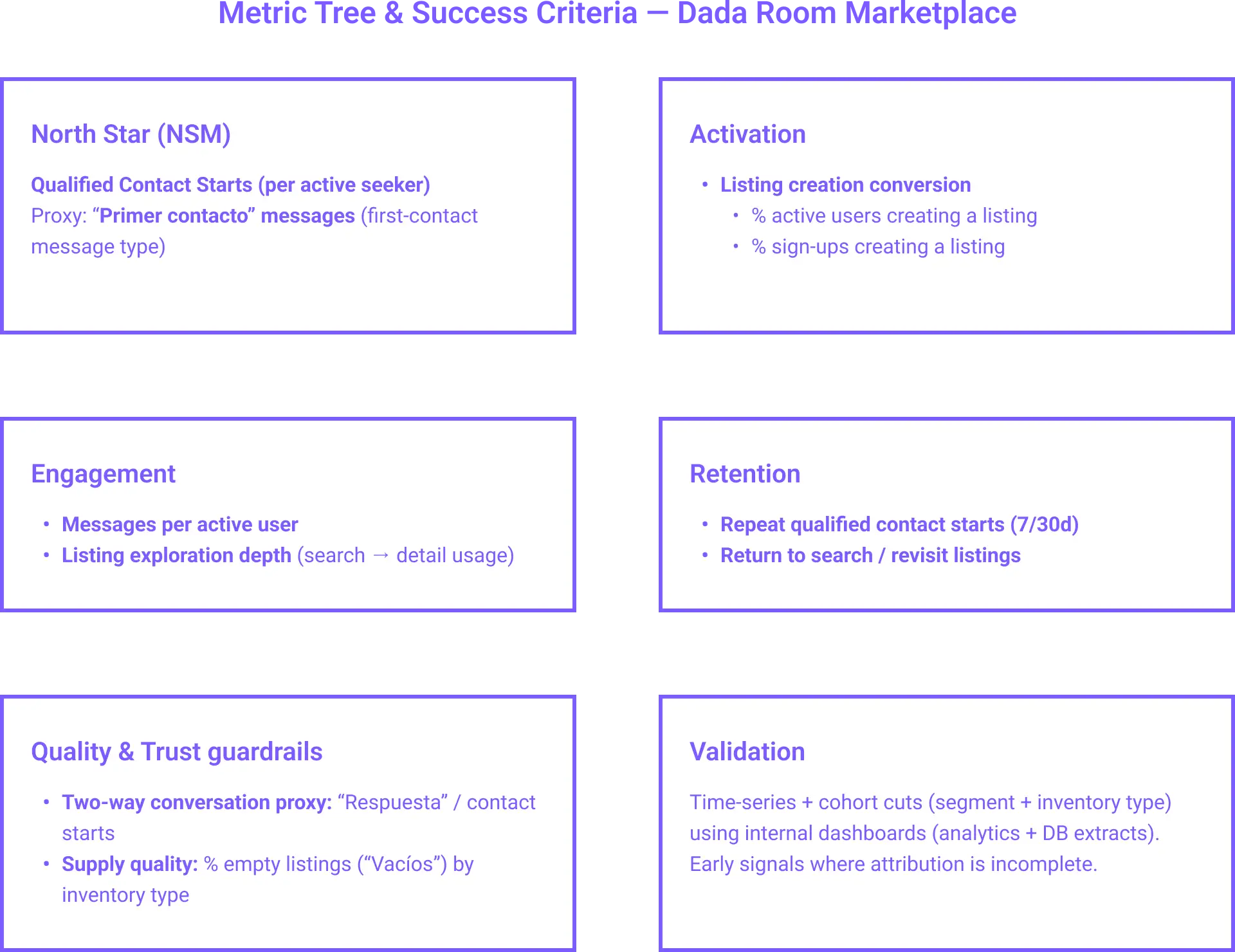
North Star (NSM)
Proxy tracked as “Primer contacto” message type (first-contact messages).
Activation
Listing creation conversion (supply activation). Proxies: % active users creating a listing; % sign-ups creating a listing.
Engagement
Retention
Validation
Time-series trends + cohort/segment cuts (inventory type, role/intent) using internal dashboards sourced from analytics and DB extracts; “early signals” where full attribution isn’t available.
Research insights
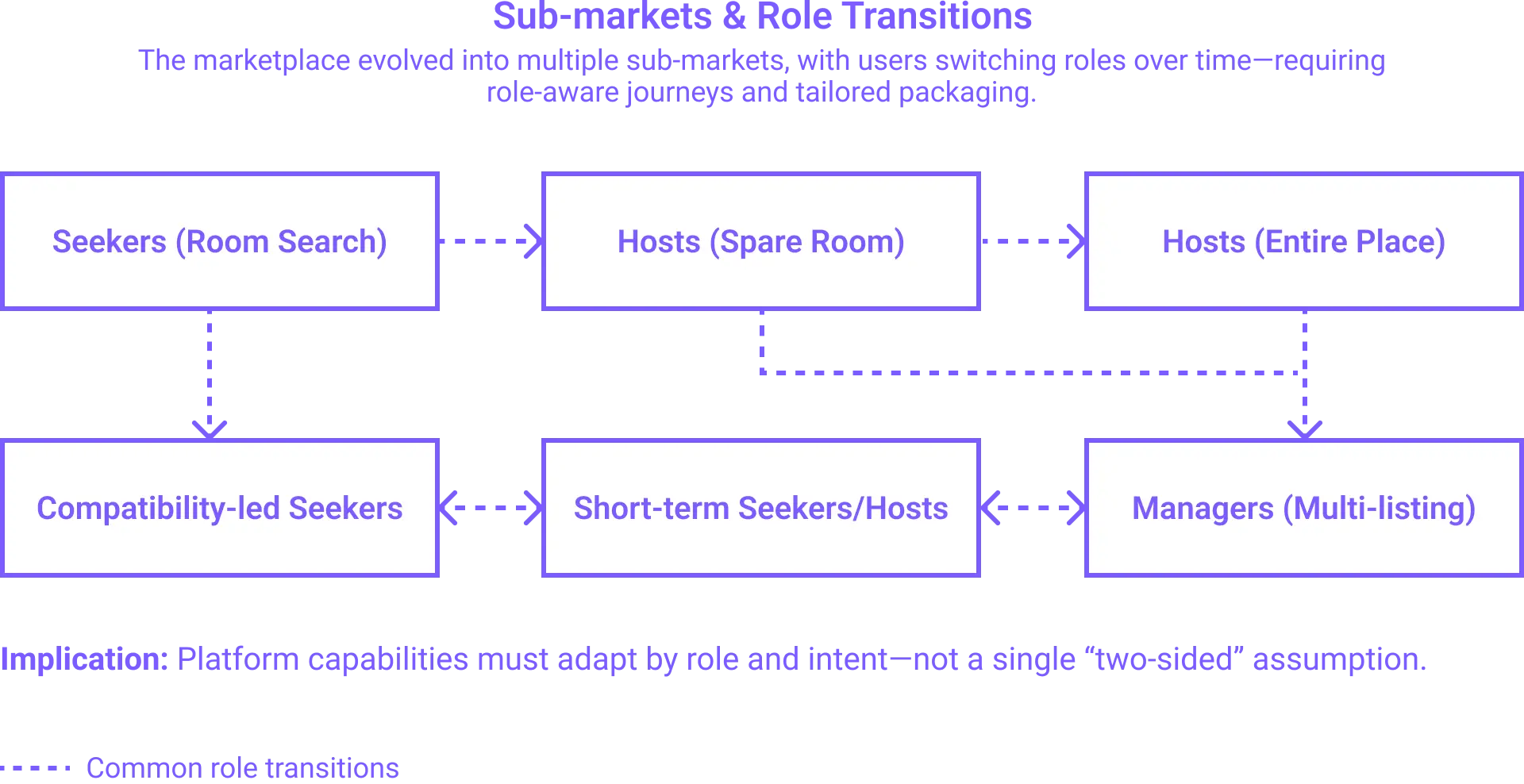
A single “two-sided marketplace” mental model broke over time. The platform expanded into sub-markets: seekers, hosts (spare room vs entire place), short-term use cases, compatibility-led seekers, and multi-listing managers. Users could shift between these roles, sometimes repeatedly.
Discovery had to support two inventories without resetting intent. Users don’t search for “a thing”—they search for a match. Switching between people (roomies) and places (properties) needed to preserve location, budget, and preferences.
Contact is the real conversion point, but it must be protected. In a housing marketplace, low-friction contact can quickly become spam. “Qualified contact” required guardrails, clear expectations, and trust cues across the journey.
Multi-session behavior is the default. Housing decisions unfold across multiple sessions, so continuity (revisits, conversation pickup, saved exploration) matters as much as first-session conversion.
Design Decisions
Why
Unified discovery across inventories via a filter switch (Roomies ↔ Properties). Why: preserve intent and reduce cognitive load while pivoting inventory type. Trade-off: higher taxonomy complexity and tighter component governance. Expected impact: more confident progression to qualified contact starts.
Trade-offs
Standardize decision units (cards + detail templates) across both types. Why: improve comparability and reduce ambiguity at scale. Trade-off: limits one-off layouts; requires content rules. Expected impact: higher search→detail engagement and cleaner intent actions.
Expected impact
Treat contact as a quality-gated capability (not a feature). Why: protect trust and reduce noise while enabling monetization surfaces. Trade-off: added friction; optimize for quality, not raw volume. Expected impact: better NSM quality and stronger two-way conversation proxies.
Solution
Patterns / Flows / Modules / Templates
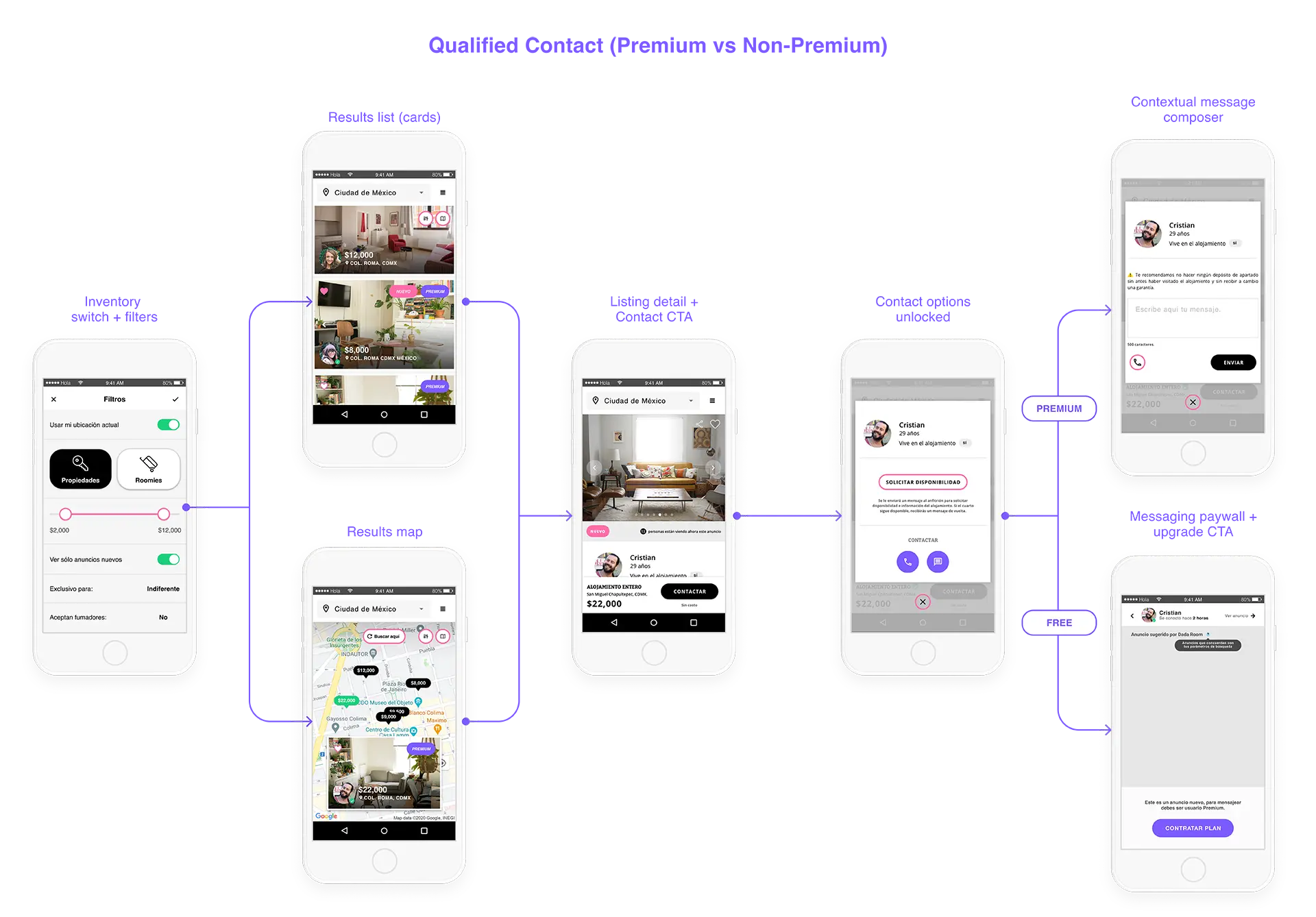
Unified search + filters that allow switching inventories without restarting the journey.
Responsive / Mobile-first / A11y
Consistent listing cards + detail templates that keep “what it is / why it fits / how to contact” predictable.
Tie-back to business objectives
Role-aware contact mechanics (Premium vs Non-Premium paths) guiding users from discovery to qualified contact starts.
Resultado
Metric 1
Scale (2015→2018):
Metric 2
Qualified contact (2018 proxy):
Metric 3
Activation (2018):
Method 1
Registered users 53,566 → 760,863 (+1320%); total listing base 36,220 → 558,823 (+1443%).
Method 2
Contact starts per active user 0.37 → 0.90 (peak), using “Primer contacto” as the proxy (time-series / early signals).
Method 3
% active users creating a listing 20.1% → 44.6% (peak) (time-series / early signals).
Systemization & Reuse
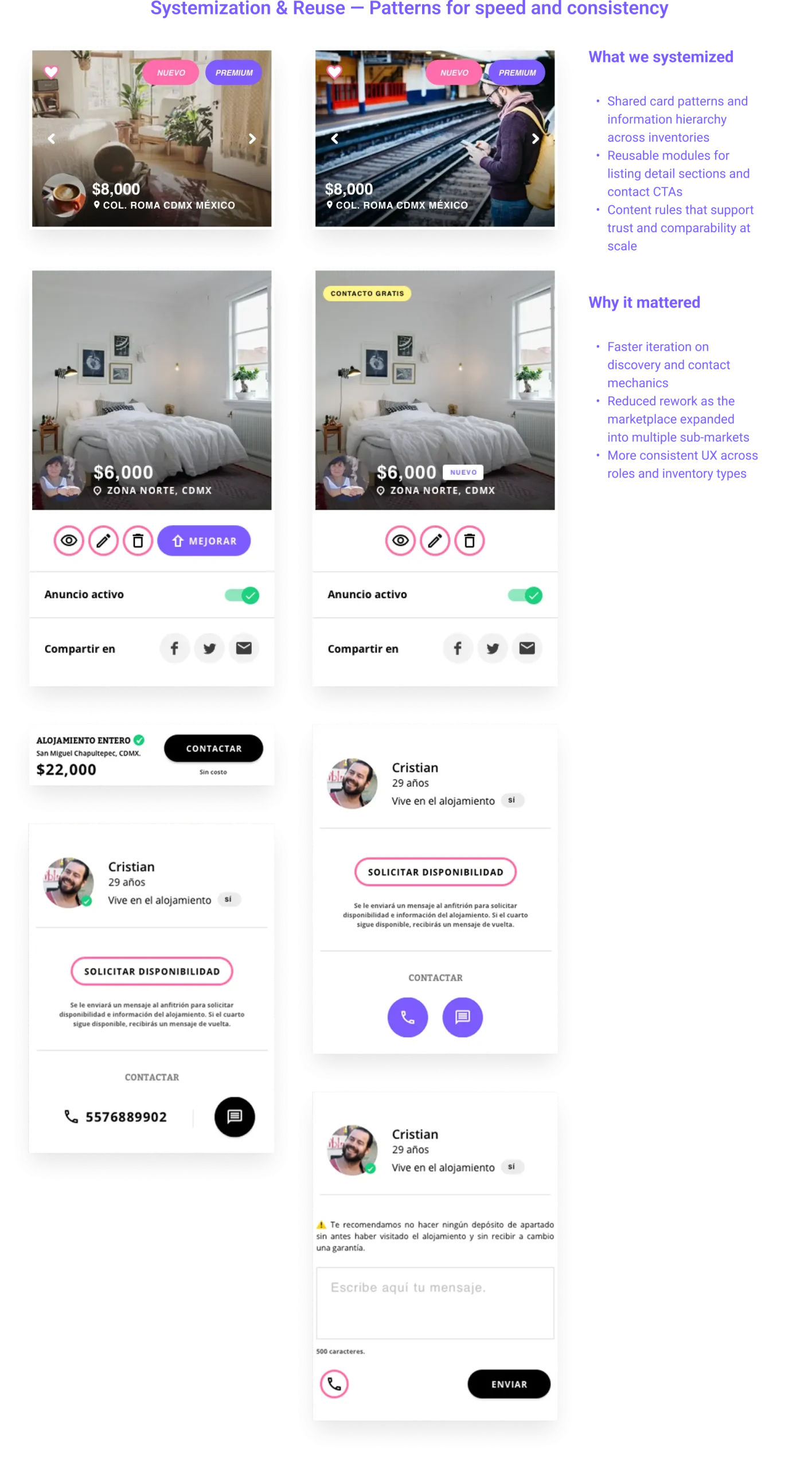
Systemized reusable UI patterns (cards, detail modules, contact CTAs) to reduce rework and speed iteration as roles, inventories, and journeys expanded.
What I'd Do Next
Credits
Product strategy, platform UX, and design direction: Juan Avalos · Team: engineering, ops, marketing, support.
Tools
Tools varied over time (Sketch/Figma + analytics dashboards/internal reporting).
Project Links
Tags
Marketplace · Platform Design · Systems/Design System · Trust & Safety · Activation · Monetization · Mobile