Legacy blog wasn’t salvageable; editors depended on engineering and recirculation/performance were weak.
Strategy
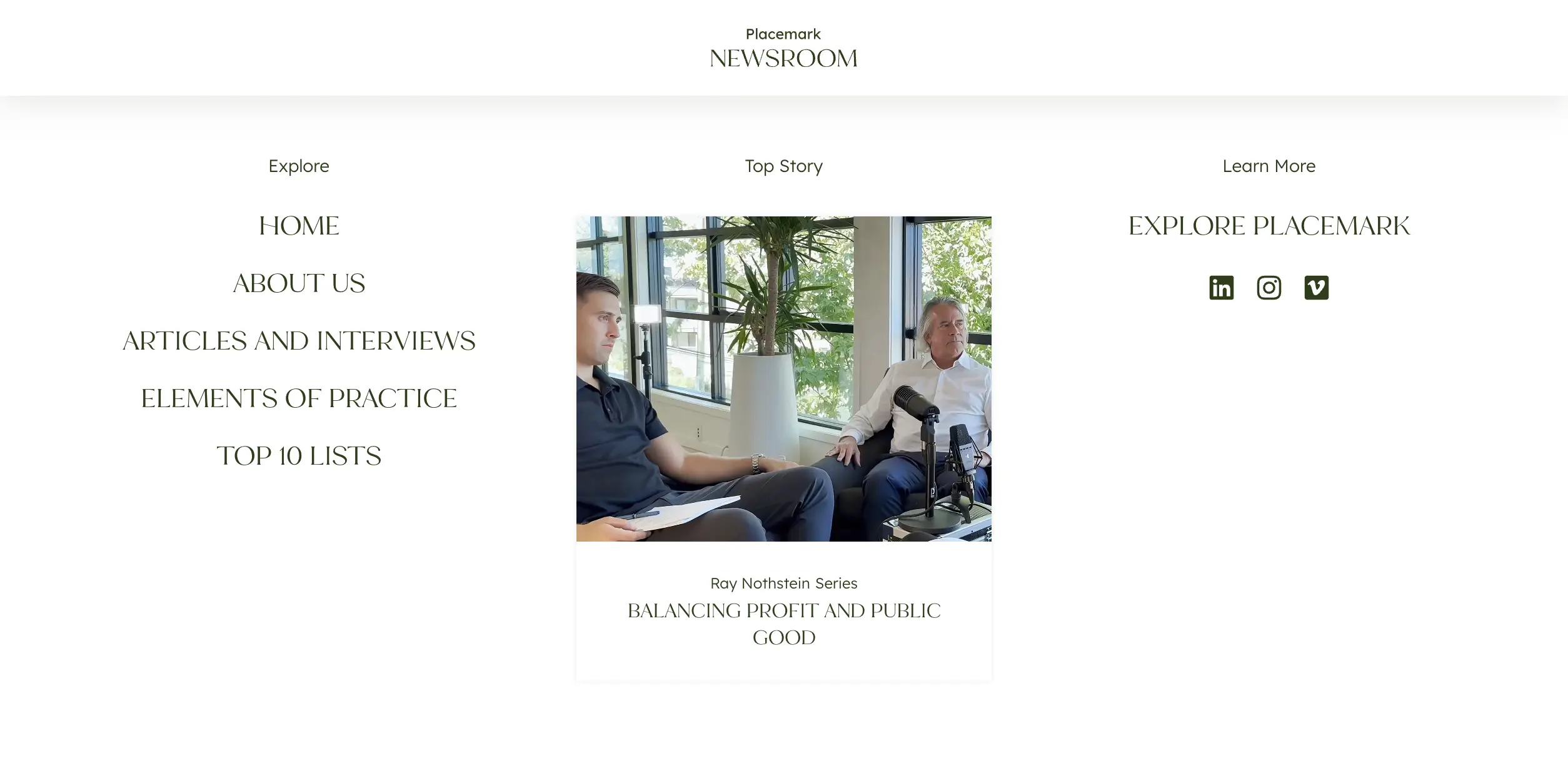
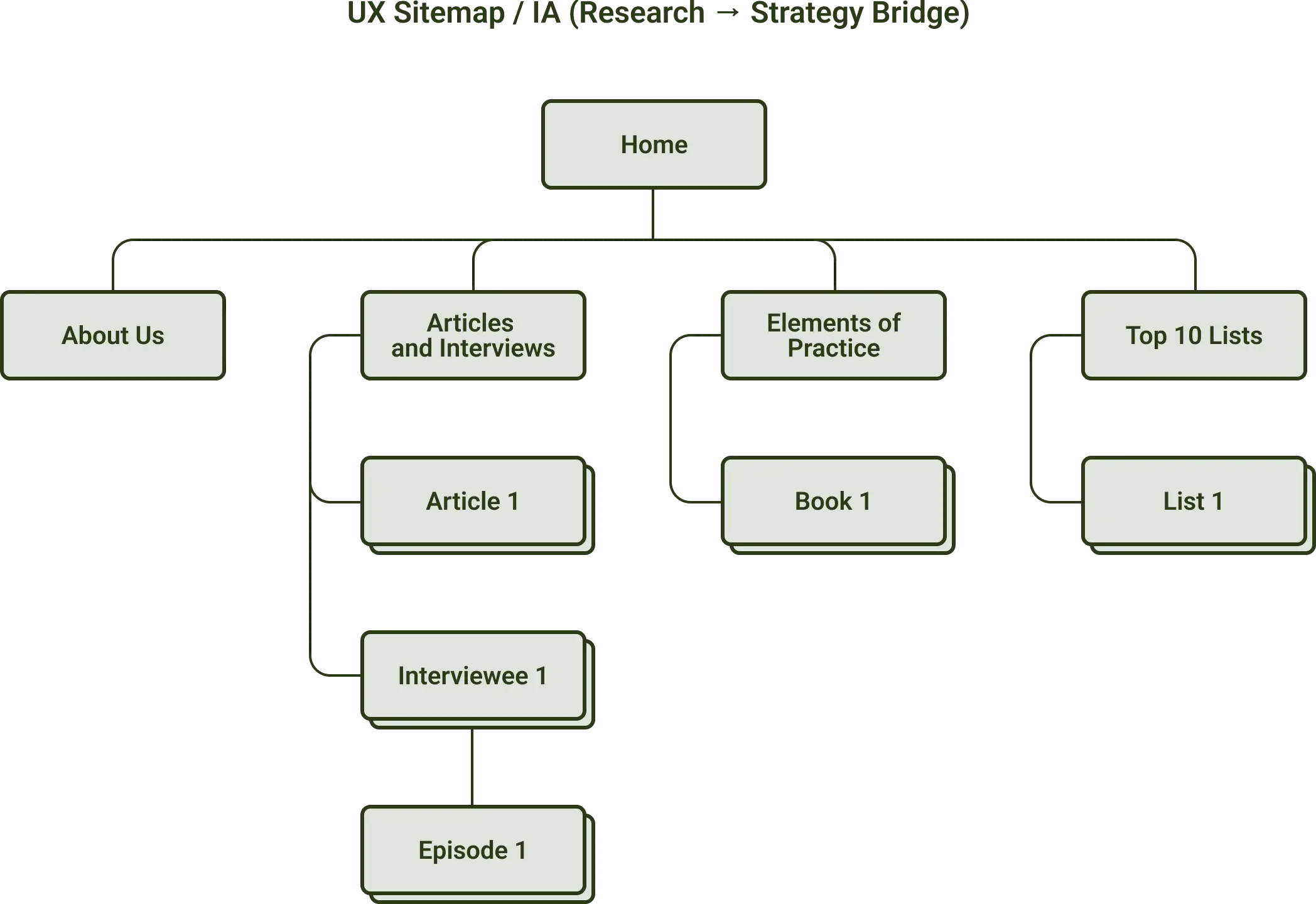
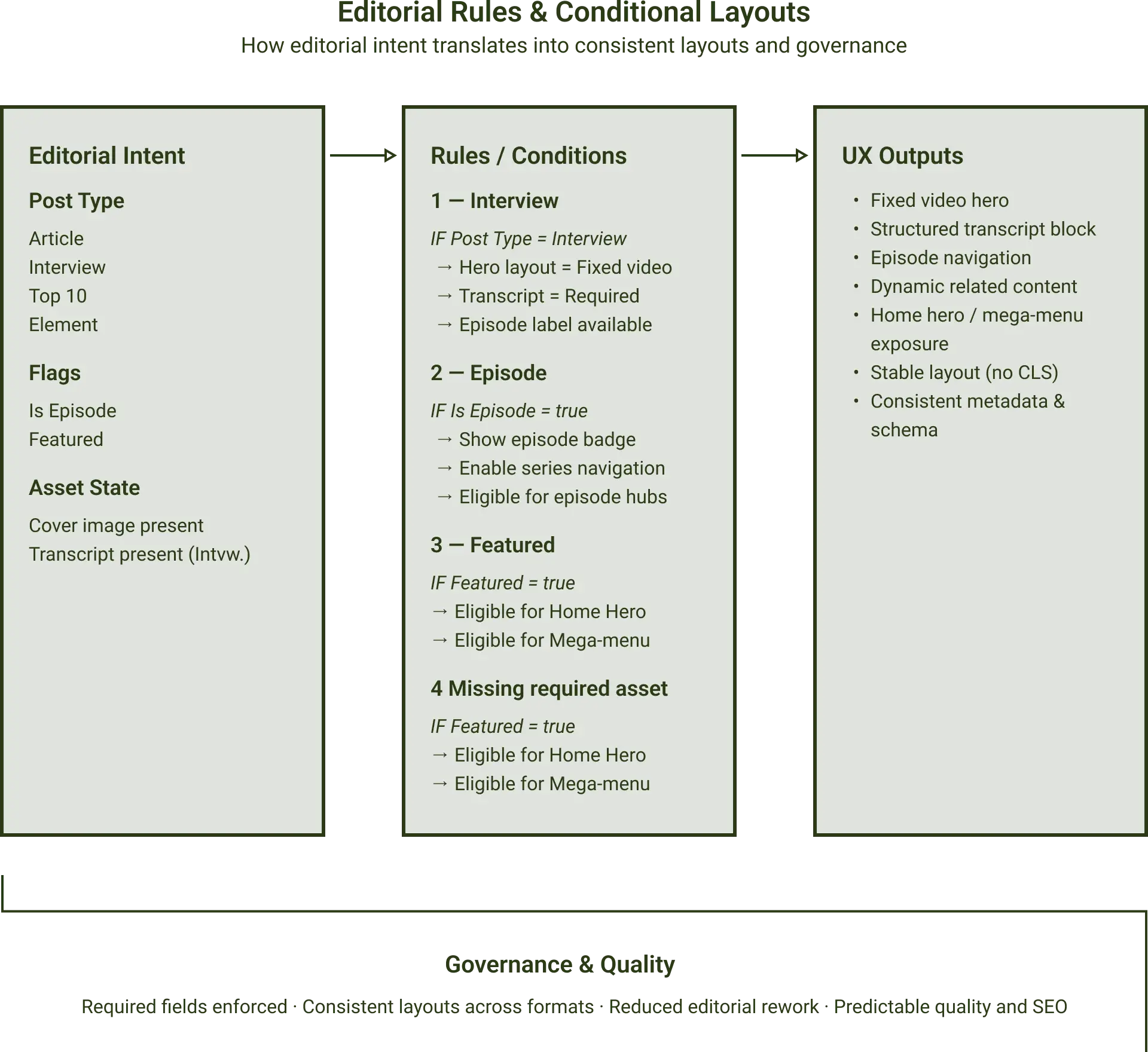
Replace with a structured newsroom (WP + Elementor + ACF + MU plugin) using narrative IA, four typed post templates, enriched navigation, and governance for assets/transcripts—prioritizing autonomy, reading flow, discovery, and CLS guardrails.
Impact
Editors publish independently; typed/conditional templates reduce rework; CLS risk mitigated with aspect-ratio & pre-sizing; hosting hard limits handled via .htaccess and conservative caching. GA4 via GTM (incl. session_qualified) verified.
Metric Tree & Success Criteria
North Star (NSM)
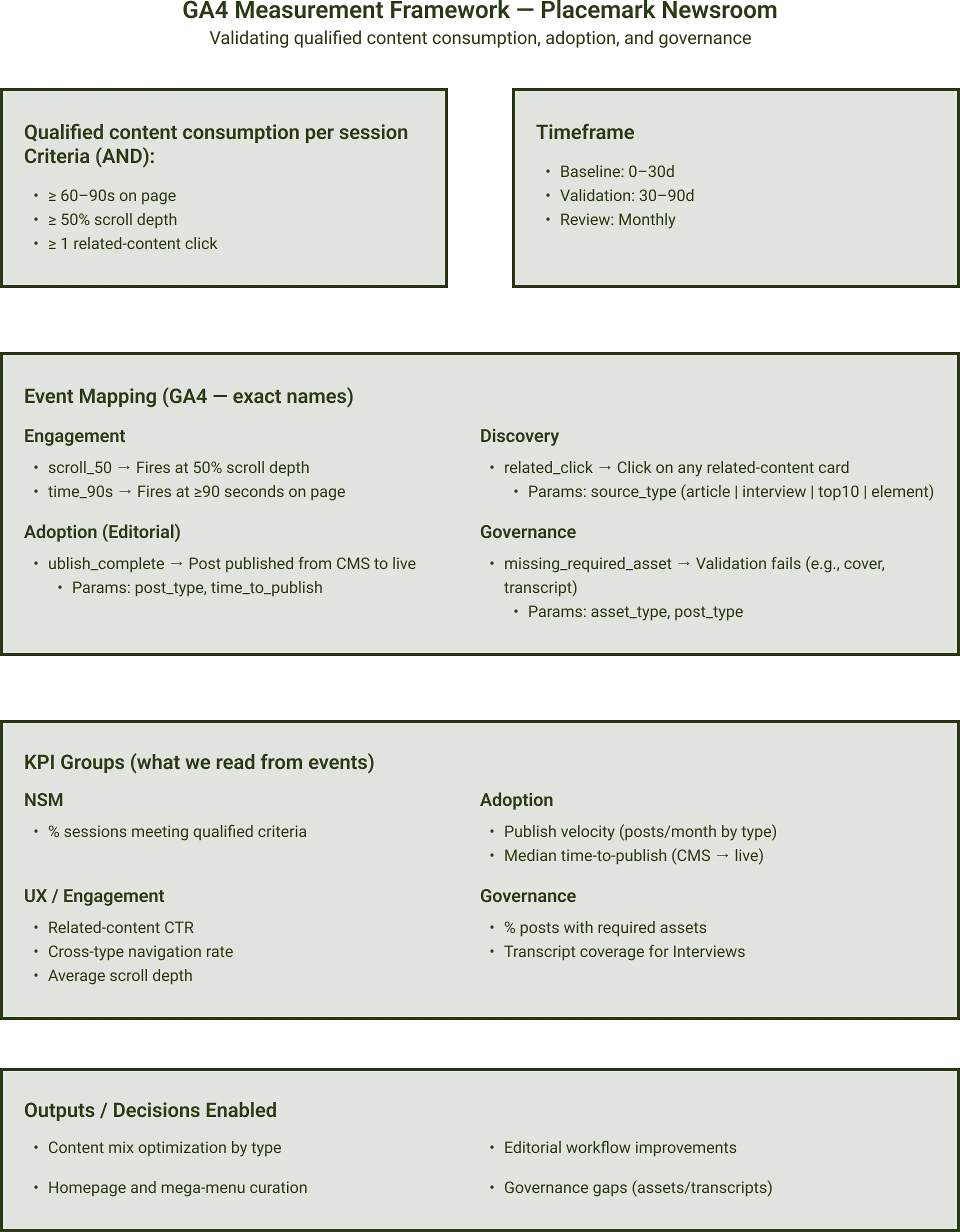
Qualified content consumption/session (≥60–90s on page, ≥50% scroll, ≥1 related click).
Activation
% of editors who publish end-to-end without engineer help.
Engagement
Related-content CTR;
cross-type navigation;
average scroll depth.
Retention
Return visits to Topics/Collections at 30/60/90 days.
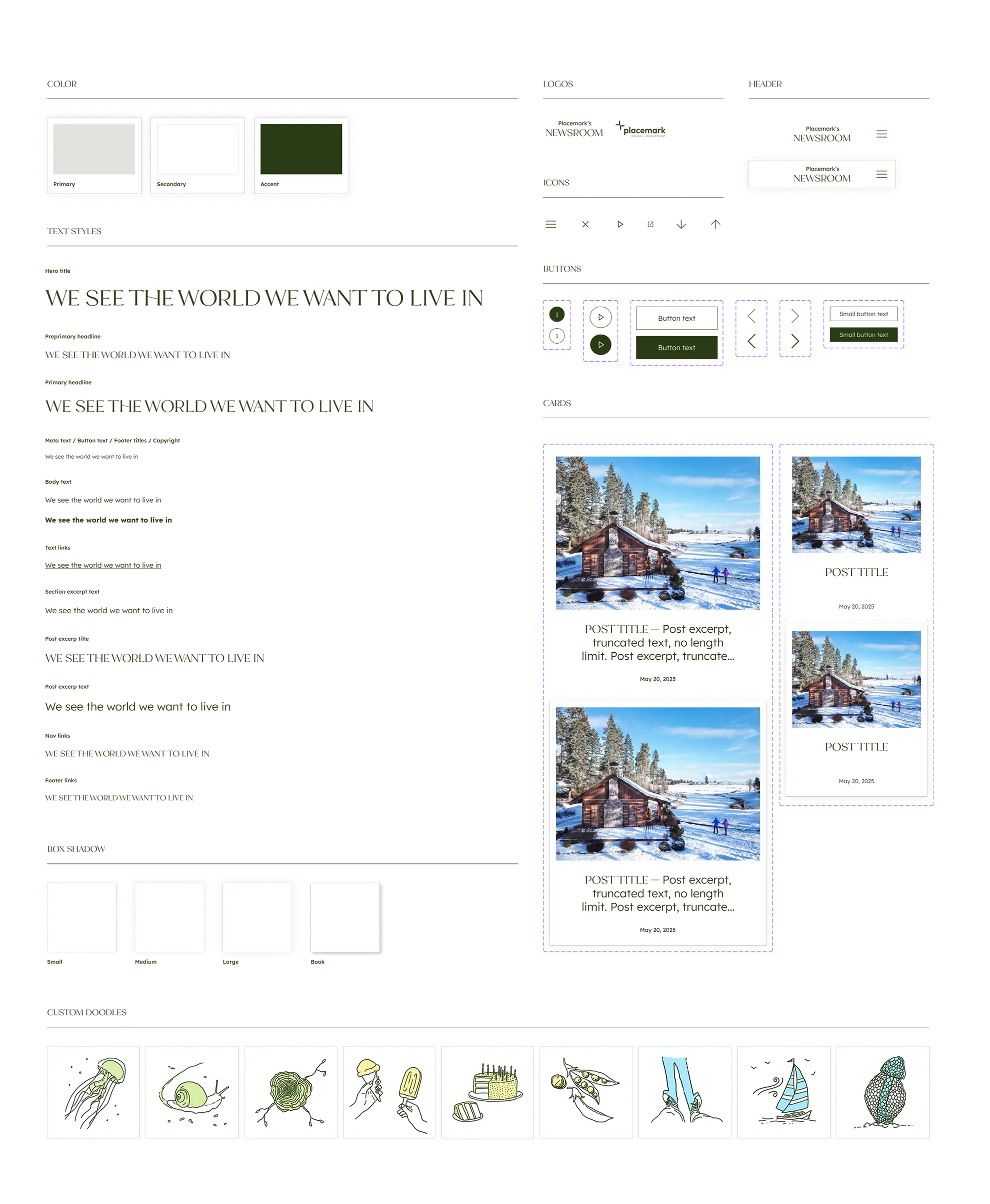
Modules: hero/featured, grids/carousels, Elements chapters, Interview video+transcript, breadcrumbs/JSON-LD, contextual CTA.
Templates: four single templates + per-type lists; reusable loop grids; MU-plugin “Next episode.”
Responsive / Mobile-first / A11y
Responsive: mobile-first; enforced aspect-ratio on cards to avoid CLS; images with object-fit and pre-sizing; preconnect/preload for fonts/hero.
Accessibility: full-card link with keyboard focus and aria-label; 44px touch targets; logical reading order; ALT text/transcript prompts; visible focus/hover states.
Performance UX: custom fonts with font-display: swap; hero image preloaded for LCP; conservative caching given host limits.
Discovery & recirculation: enriched nav + related modules deepen reading paths.
SEO trust: typed structure + JSON-LD + dynamic meta keep content consistent and machine-readable.
Scalability: reusable components/rules reduce change time and errors.
Interviews pair a fixed video header with structured transcripts to improve accessibility, SEO, and long-form consumption.
Dynamic related modules promote cross-type discovery, deepening session paths.
Results
Metric 1
Operational autonomy: editors publish end-to-end without engineering; conditional templates reduce rework. (Window: launch week + first 2 weeks.)
Metric 2
Time-to-publish: ~1–5 minutes from CMS to live (by content type). (Window: 6 timed dry-runs per type during handoff week; baseline established post-migration.)
Metric 3
Qualified consumption per session: sessions with ≥60–90s on page, ≥50% scroll, and ≥1 related click (session_qualified event). (Window: first 14–30 days baseline for the new system.)
A 30–90 day GA4 measurement plan validates the North Star metric while tracking adoption, UX, and governance to inform editorial and product decisions.
AI Patterns
Patterns (future-ready): semantic search across posts, suggested related reading, anomaly hints for underperforming topics.
Systemization & Reuse
Reusable card/hero variants and related modules across Single/Archive.
Content rules (required fields, transcript policy, schema prompts).
A lightweight component kit with custom doodles keeps the system distinctive while enabling fast iteration.
What I'd Do Next
A/B headline/hero variants.
Topic-based recommendations.
Credits
Contributors: Client Executive Sponsor; Editorial Owner; SME Editors; Product & UX: Juan Ávalos.
Tools/Stack: WordPress 6.8.3 + Elementor Pro + ACF; custom CSS; MU plugin; GA4 + GTM; Figma/Notion/Slack. Hosting: Webnames (LiteSpeed), SSL manual.
Tools
WordPress 6.8.3, Elementor Pro, ACF, Google Tag Manager, GA4, Google Search Console, Figma, Lighthouse/PageSpeed Insights, Webnames (LiteSpeed)
Design Systems, Performance, Editorial CMS, UX Strategy, Accessibility, Media
Next case
Naya Homes
Unified operations portal for property teams, combining performance dashboards and reservation workflows to reduce context switching and manual coordination.